A little bit more...

Monday, May 07, 2007

Difference among Swing, AWT, SWT and JFace

Introduction

I know questions like telling the differences among Swing, awt, SWT and JFace or some of them are frequently asked in an interview for Java programmers. I don't use them very often and extensively, nor do I know too much about those four things, especially from the implementation perspective or the guru's best practice perspective. But I do read some materials and figure out some conceptual difference between those four things that I think would suffice answering such questions in an interview.

AWT and Swing

-AWT

AWT stands for abastract window toolkit which comes with an early release of the Java Programming Language ( about 1.1 ). AWT components are referred to as heavyweight components. It is implemented as having "peer" native code for every widget you create. Most of the significant logics (including the core event handling logic) of the toolkit are written in C/C++, for which via JNI (Java Native Interface) your GUI program may directly calls those "peer" native code. It means all of the drawings of your GUI are done directly by the graphic API of the underlying operating system. This implementation underlies several limitations:

  • Not all the operating system support the same set of native widgets, so a "least common denominator" philosophy is used when shipping the AWT library, that is only a basic set of components are provided as library via which you write your GUI. So no complex components such as slider, tree and table can be found in AWT components, which you have to build yourself either through directly writing native code as AWT is implemented, or through writing Java codes which wraps AWT ( this is the way Swing is implemented).
  • Because the core logic are hided from you in the native code, debugging your GUI program can be annoying.

This kind of implementation also results in your GUI implemented with AWT always having the same look and feel as the underlying OS.

-Swing

In contrast, Swing components are known as lightweight components, because Swing doesn't implement the underlying drawing and event handling logic which are delegated to the toolkit in this case AWT, on which it is built on. As mentioned above, Swing is implemented by pure Java codes. So it is conceivable that Swing has the portability that AWT doesn't have, and that Swing has almost all the nontrivial complex components. Swing can also have the same look and feel on all OS, and can also be switched to another style of look and feel at runtime regardless of the underlying OS. It is said that Swing has a better performance than AWT, however, from the implementation logic so far I've known, I can't tell why. Swing seems well known for its good design and architecture.

-Never intermix AWT and Swing

I know a lot has been said and written about this subject. The first item in the resources section is a good example of that.

SWT and JFace

-SWT

SWT, short for standard widget tookit, is originally introduced by IBM, as a substitute of AWT. SWT now is as part of the eclipse platform based on which the eclipse GUIs are implemented. SWT is very similar to AWT conceptually, however, the underlying implementation is a little different. Different from implementing all the core logic in "peer" logic in native code, SWT bears a thin JNI layer which is used for directly call the GUI API of each underlying platform. All the significant logics are written in pure Java codes in which the thin JNI layer is used. So almost all the limitations AWT has are elimintated in SWT. Other than this, better performance are gained, for which I don't know the specific reason. As of AWT, SWT has a consisten look and feel as the underlying OS.

Disadvantages of using SWT:

  • Reuire a native library (This also holds true for AWT).
  • Low level of abstraction (This also holds true for AWT).

-JFace

JFace is conceputally similar to Swing. The relationship between JFace and SWT is very similar to the relationship between Swing and AWT. It works above the level of raw widgets, in this case, SWT. JFace has a rich set of complex widgets.

Resources

  1. Why You Shouldn't Mix AWT and Swing
  2. What is the difference between AWT and SWT
  3. what is difference between swing and awt
Technorati tags: , , , , , ,

Thursday, May 03, 2007

Exception as Non-Exception

Introduction

Quotes: One of the unexpected benefits of exception handling is better performance because many errors can be processed centrally instead of after each function call. - by Bruce Eckel, the author of Thinking in Java.

-First, what is exception?

In JVM SPEC, an exception is defined to be an error that JVM would signal to a program if a program violates the semantic constrains of the Java programming language. But that’s not the complete fact, more generally, causing an exception is considered to be an exceptional condition or abnormal state that a program is in. So besides violating the semantic constrains of a programming language, which may be a critical and unrecoverable condition, breaking the assumption on the logic functionality of a program can also be considered to be exceptions. From a more formal perspective, every statement, method or generally, module are expected to fullfill some implicit or explicit contract, and an exception indicates the inability to fullfill the contract. Regardeless of the context of the specific programming languge (such as Java) exception handling mechanism, exception and error are interchangeablely used.

-Second, what is exception handling?

Informally speaking, exception handling is what you do about the exceptional condition. However, though an agreement on the defintion of exception are generally achieved, exception handling mechanisms are from time to time debated on. Generally, three techinques / mechanisms / notions are concerning with exception handling. First, exceptions can be identified by returning distinguished error values and handling exceptions is immediately done based on the error values. This is the most conventional way of identifying and handling exceptions. Many large system written in C or most conventional procedure languages utilize this way. Second, exceptions identifying and handling are distinguished from other features that a porgramming language provides. This can be found in many modern OO language such as C++ and Java. An Exception class (or method ?) is and can be designated for each kind of exceptional condition, and special satements with special keywords are introduced to notify ( or throw ) the condition and then handle the condition, usually at different places in your program. Third, exceptions are covered or at least not emphasized based on the assumption that a module and the client of a module take clearly divided responsiblities. This is mainly concerning an OO design principle called design by contract, DBC for short.

Old-fashioned style by returning distinguished error values

When encountering an error, return distinguished error values that are not considered normal return values. For example, a method that is to calculate the square root of a number doesn’t consider a negative number as a normal return value, so returning -1 / -2 / -3 indicates an error. The client code can distinguish a normal return value from error return values, so the client programmer can write code to cope with each exceptional condition according to returned error values, each of which indicate a kind of exceptional condition. E.g.,

int sqrt( int num )

{

if ( .. ) return -1;

else if ( … )

{

return -2;

}

}

-pros and cons

pros: Both notifying and handling exceptions are light weight. 1) No extra mechanisms are needed to notify and handle exceptional condition, which means codes notifying and handling exceptional conditions are executed in exactly the same way other codes that solving the core problems runs. 2) This will not introduce any extra runtime overhead for exception handling.

cons: 1) This idiom tend to cause spaghetti codes. It will complexicate your method codes by having to place many error checking codes. 2) Agreements on what each error value means must be established between the author and the user of the method. And if the same meaning of an error value must be used among more than one method, the global agreement is hard to be established. For instance:

return -1, if the passed in argument <>

3) For the client code, it is not enforced to handle any exceptional conditions. In other words, it’s completely up to the client programmer whether or not to handle any exceptional conditions. 4) In addition, even exceptional conditions are to be handled, duplicate codes must be written for each call of the mehod, that is, several calls to the same method requires several times of handling several same kind of exceptional conditions which means codes for handing exceptional conditions can’t be centralized and thus be reused. 5) More worse, handling exceptions must usually be followed immediately after recieving the error values, regardless of whether or not the then’s current context can provide enough information to handle the exceptions. That is, it is hard to propagate the exception to the right level of abstraction only on which such exceptions can be properly handled.

Exception handling style

Utilize dedicated constructs, such as Exception types, to represent the exceptions and collect information about the exceptional conditions, and handle exceptions based on information wrapped in such constructs.

-pros and cons

pros: 1) Exceptions and their handling are standardized as part of the features of a programming language that are distinguished from other features of that language. Handling some kinds of exceptions are enforced by the compiler, which means the learning curve are to some degree flattened. It less depends on the experiences, but are forced to be done. 2) Agreements on what exception means are easily established by the kind of dedicated constructs. And global reuse of these agreements needs no extra effort. 3) Though, it will stil cause spaghetti codes, it is alleviated by exception handling mechanism enabling that some exceptional conditions (such as access members on a null reference) are automatically notified in the standard way which means less error checking codes are needed. 4) Exceptions notifying and handling are loosely coupled, that is, identifying exceptions and handling them can be at two point far away from each othe in the control flow. This also means it is easy to propagate exceptions to the right level of abstraction on which such exceptions can be properly handled. 5) Due to easily propagating exceptions, handling the same kind of exceptions can be centralized, for which someone argues that unexpected performance benefits will be get as opposed to old-fashioned error values way.

cons: 1) Extra runtime overhead are needed to notify and handle exceptions for which at the implementation level, extra transfer of control is needed. 2) Client codes are complicated by exceptions handler codes which are more obvious if exceptions notifying are misued and/or overused.

Design by contract

A contract is established, explicitly or implicitly, between a module and the user (client code) of the module. Any side must comform to the contract at any time, under any circumstance. The contract consists of precondition, invariant and postcondition. Whenever wherever the module is called (used) the precondition must be met, and after executing the module, the postcondition must be met. In the whole process the invariant must always be met. Obligations and benefits for both parties are specified. It is the obligation of the client to ensure the precondition is met before calling the module, and that of the module to ensure the invariant and postcondition are met. So any party is committed to its obligation regardless of the other party’s obligation.

More specificly, the client will check and ensure the precondition is met before it calling the module, so on most occassions, no exception mechanism is needed. Because if the contract is always conformed to, no exceptions are foreseen. But, usually, extra mechanism, such as assertion, is needed to help tell and/or check whether or not the contract is conformed to. However, even no such extra mechanism is provided, the idea behind DBC can also be used to prevent from overusing exceptions which may be caused by defensive programming. In general, DBC is sometimes considered to be a formal method.

p.s., the DBC community considers returning error values and exception handling two rivals :)

Defensive programming

The philosophy of defensive programming can be summed up as: Better to check too much, or check redundantly, than to check little. This is in contrast to DBC which advocates guaranteeing more by checking less. It is conceivable that defensive programming is caused because the contract in DBC is not established at all. Actually, defensive programming goes to another extreme. It assumes that the other party never burden its obligation, such as ensuring the precondition, so the module will itself burden others’ obligations, such as checking for the precondition. This is mainly responsible for complexity and obscureness of codes. For instances, we have a module:

int sqrt( int num )

{

if precondition is met then

solve the problem; return …

else return …

}

and we have a snippet of client codes to call that module:

if preondition for sqrt( .. ) is met then

call sqrt( .. );

Pseudocodes in bold are caused by defensive programming. This way of programming are extensively common.

Exception handling in Java

When an exception is thrown, the JVM will transfer the control from the point where the exception occur to the point that can be specified by the programmer. During the process, the JVM abruptly completes, one by one, any expressions, statements, method and constructor invocations, static initializers, and field initialization expressions that have begun but not yet completed the execution in the current thread. The process continues until a handler for the thrown exception is found. If no such handler is found, then the method uncaughtException is invoked for the ThreadGroup that is the parent of the current thread.

If a finally clause is executed because of abrupt completion of a try block and the finally clause itself completes abruptly, then the reason for the abrupt completion of the try block is discarded and the new reason for abrupt completion is propagated from there.

If a method throws an exception, it must assume that exception is “caught” and dealt with. One of the advantages of Java exception handling is that it allows you to concentrate on the problem you’re trying to solve in one place, and then deal with errors from that code in another place.

Goal of exception handling

Make your program more reliable, robust and error-tolerant. Usually, it provides measures for you to be notified of the exceptional condition and recover from that condition.

Best practices in Exception handling

Below are some best practices in exception handling citing from the book “Effective Java”.

-Use exceptions only for exceptional condition

Prevent from overusing exception.

-Use checked exceptions for recoverable conditions and runtime exceptons for programming errors

Three kinds of exceptions: checked exception, unchecked exception and errors. By convention, errors must be used only by JVM. Programming errors may be considered to fail to fullfill the contract and are generally unrecoverable.

-Avoid unnecessary use of checked exceptions

Two reasons: first, exceptions handling needs extra runtime overhead; second, checked exceptions are forced to be caught which would complexicate your client code. This to some degree conforms to DBC by advocating the client code calls state-testing methods which actually is to ensure the precondition.

-Prefer standard exceptions over user-defined exceptions

For learning curve about your codes, understanability and portability of your codes.

-Throw exceptions appropriate to the abstraction

Exception translation, Exception chain.

-Document all exceptions thrown by each method

Javadoc style, or declaration using the keyword throws which is also called the exception specification.

Exceptions as a part of the specification of a method.

-Include failure-capture information in detail message

Refers to the goal of exception handling

-Strive for failure atomicity

Refers to the goal of exception handling

-Don’t ignore exceptions

No empty catch block.

Other guidelines

-User visible error message should not be the same as the failure message wrapped in the exception object (needs further investigation). The latter are only for programmer to debug the program.

-Don’t assume the way which the client codes burden their obligation and/or the degree to which they burden their obligations. However, unfortunately, defensive programming is often needed, though you should try your best to avoid.

Resources

  1. Chapter 8 Exceptions, Effective Java.
  2. 2.16 Exceptions, Java Virtual Machine Spec.
  3. Chapter 10 Error Handling with Exceptions, Thinking in Java 2nd version.
  4. Building bug-free O-O software: An introduction to Design by Contract(TM)
  5. Design By Contract
  6. Design By Contract (DBC)

Monday, April 30, 2007

Java基础复习

Introduction

基本上是按照网上流传甚广的一套Java的面试题目来的,一个一个问题回答。

谈谈final、finally、finalize的区别

其实除了名字类似,是不沾边的三个东西。

final

Final is a keyword that can be used for classes, methods and data ( field / arguments ). It means what it modifies can’t be changed anymore. For final classes, they can’t be extended or derived; for final methods, the method’s behavior can’t be changed by overridden; for final data, they can only be initialized once and not be assigned values any more. But remember there’re two reasons for preventing change: design or efficiency.

> final methods

There’re two reasons why you make a method final: 1) quite small final method can be inlined when they’re called which is more efficiently; 2) you don’t want a method to be explicitly overridden.

Private methods are considered to be implicitly final, because in whatever cases, you can’t access or override a private method.

> final data

A misconception ( maybe it’s only mine : ) is that declaring data to be final doesn’t necessarily mean that its value is known at compile-time. The value can be run-time determinable. And data can also be declared to be final without any initialization value. In this case the final datum is called blank final field which has to be initialized in constructor or static initializer, or somewhere before use.

> final classes

Defining classes as final simply prevents inheritance — nothing more. Since a class declared to be final can’t be inherited, all its methods are implicitly final and the complier can opt to bring efficiency for you as with other explicitly final methods.

finally

Finally is to do with Exception handling which can introduce a piece of code that you want to execute whether or not an exception is thrown within a try blok or catched in a catch block.

finalize

Finalize which is the name of a method of Object is to do with garbage collection, that is to do with memory release. Garbage collection in java is a two-pass process. In the first pass in which case the object is eligible for garbage-collected, garbage collector will call finalize(), and in the second pass in which case the running programm may reach the point of runing out memory, garbage collector may physically release memeory of eligible objects. So the storage of a finalized object isn’t necessarily get released.

Anonymous Inner Class (匿名内部类) 是否可以extends(继承)其它类,是否可以implements(实现)interface(接口)

The answer is yes for both cases.

Inner class constructors get passed a hidden parameter, a reference to the outer class object that created them. static nested classes don’t have this hidden parameter. This is analogous to the way instance methods have hidden this parameter, where static methods do not.

Inner classes are not permitted to have static methods or fields. That is not quite true. They are allowed static final compile time constants, which are treated as if there were literals. If inner classes need statics, they have to get the outer class to hold them, or you have to use static nested classes or you have to inherit the static fields. Oddly, inner classes are permitted to extend classes that do have static methods and fields.

Anonymous inner class can’t define constructors. An anonymous inner class implements an interface, say, ITest, by:

new ITest() { .. }

and extends a class, say, Test, by:

new Test( name) { .. }

where Test( String name ) is an non-default constructor of Test, and default constructor can’t be used here!

For which kind of classes an anonymous class can extend / implement, refer to nested classes : Java Glossary.

Static Nested Class 和 Inner Class的不同

Differs in creating instance of them, and linking with the outter class /instance.

&和&&的区别

& is bitwise AND ( 位与) operator, while && is logical AND (逻辑与) operator.

Shift operators

The left-shift operator( << ) produces the operand to the left of the operator shifted to the left by the number of bits specified after the operator( inserting zeroes at the lower-order bits ). The signed right-shift operator( >> ) produces the operand to the left of the operator shifted to the right by the number of bits specified after the operator( inserting zeroes / ones at the higher-order bits ). There’s an unsigned right-shift operator( >>> ) will produces results inserting zeroes at the higher-order bits regardless of the sign.

Shift operators can be combined with equl sign, such as, <<=, >>=, and >>>=.

Talk about collection framwork in Java 2

Main interfaces: Collection, List, Set, Map. There’re actually only three collections List, Set and Map, and only two or three implementations of each one. And Map is not derived from Collection. The reason putting it the collection framwork is because a Map can produce collections from its key set and value list. Refer to chaper 9 of Thinking in Java 2nd version and Sun’s Java library for full details.

All collection implementation requires type checking ( especially with generic feature in Java 5 ) or bounds checking, or both.

Vector is synchronized, which means it’s thread-safe.

ArrayList is much like an array except it is variant-sized which brings extra run-time overhead.

The List interface provides four methods for positional (indexed) access to list elements. Note that these operations may execute in time proportional to the index value for some implementations (the LinkedList class, for example). Thus, iterating over the elements in a list is typically preferable to indexing through it if the caller does not know the implementation.

For the Set interface, a speicial case of prohibition is that it is not permissible for a set to contain itself as an element.

Diff between Collection and Collections

First Collections is the name of a conceptual framework coined by the designers of Java to represent a collection of interfaces and / or classes that enables an object holding a group of objects and variaous operations on it. It is generally called the collections framework ( or container classes before Java 2 ).

Collection as a type name is the name of an interface which is the root of the collecitons framework hierarchy and is located at package java.util. While it is the root of the collection hierarchy, there’re some collection classes that aren’t rooted from it, such as Map.

While Collections is a class also located in the package java.util which consists of a variety of static methods that operate on or return collections. This is common technique used to organize a bunch of related PO paradigm interfaces* ( may be not types, but methods ) into one module supported by OOP paradigm to improve the modularity and/or accessability of such interfaces*. In some cases, this is called the facade design pattern. Similar classes examplifying this techinque are Arrays, Math, etc.

Diff between HashMap and HashTable

String, StringBuffer, and StringBuilder

String class represents character strings. All string literals ( e.g., “Kenyth” ) in Java program are implemented as instances of String class. Strings are constant, namely immutable, as opposed to mutable StringBuffers. Their values can’t be changed after they’re created, which makes they can be shared ( refer to a compiler theory book about handling of constants ). And any modification to a String will produce a new instance of String, explicitly or implicitly. Concatenation of String is implemented as operations on StringBuffer( see the class file bytecode ), and conversions from an object to String is facilitated by the toString() method defined in Object class.

StringBuffer class represents a sequence of characters. It is mutable. It allows for data being appended to and inserted into it. It is thread-safe.

StringBuilder is like StringBuffer, but is not intended to be used by multi threads, that is not synchronized, or not thread-safe. It is introduced as of Java 5.

When to use assert

( Actually I’ve never used this keyword in my programming ) For the full details refer to Sun’s official document Programming With Assertions.

Simply speaking, assert in Java provides you a debugging facility similar to macros in C/C++. You can enable/disable your assertions when starting your program by passing in JVM command-line arguments ea/da. However, by default assertions are disabled at run-time.

There’s one guideline for deciding where/when to use assert that you should never use it for what your programming code do, such as method contract enforcement. Because since it is just a helper tool for debugging / observing your program and can be disabled, you must not depend the functionalities of your program on it.

more are coming soon…

Resources

  1. Thinking in java version 2.
  2. JAVA面试题目(去了两家公司,都是这样的题目) :一个很好的问题导向的复习提纲。
  3. 初识Java内部类:关于内部类的好处,静态内部类以及非静态内部类。
  4. `final’ variables and inner classes: explains why access from anonymous inner class to non-final outter variables is not allowed.
  5. nested classes : Java Glossary: contains very detailed explanation of the terms nested / inner class and their usages.
  6. Programming With Assertions

Technorati : , ,
Del.icio.us : , ,

Friday, April 20, 2007

The Architecture of Eclipse

Introduction

If explaining every bit in detail, you must be missed in the details and can’t see the architecture from a global perspective, nor will you be benifited in your practise. So I’m trying to explain the architecture based on senarios such as what will happen when you startup elipse, what will happen when an action that you contribute is fired, etc. I hope in such a way it will do help in your practice with Eclipse.

And, it is worthy to point out this is not an overview on the architecture of Eclipse for which there are tons of articles written about.

Startup of Eclipse

What will happen when the file eclipse.exe is executed.

Startup of Eclilpse begins by running a system specific executable binary file called eclilpse.exe which is located under the root directory of the eclipse installation. This executable will then lauches the org.eclipse.core.launcher.Main, located in startup.jar. After that the entry point of Main, that is static main method of Main is invoked. Below we will illustrate the calling path of important methods to demonstrate the post startup process of Eclipse.

Main.run( args )

Main.basicRun( args )

Main.getBootPath( .. ) : locate boot plugin ( in “plugin” directory of your eclispe installation ), within which Main.getDevPath( .. ) is called, within which Main.addBaseJars( .. ) is called, within which Main.readFrameworkExtensions( .. ) is called; invokeFramework( .. ): invoke EclipseStarter

the class EclipseStarter ( indicated by STARTER field ) is loaded by a URLClassLoader defined as an inner class with Main; EclipseStarter.run( .. ) is invoked in a reflective way

EclipseStarter.startup( .. ) : starts the platform and sets it up to run a single application

OSGi.new( .. ) : an instance of OSGi service platform is created

OSGi.launch() : start the OSGi framework

Framework.launch()

SystemBundle.resume() : SystemBundle subclasses Bundle to provide a system Bundle so that the framework can be represented as bundle

StartLevelManager.launch( .. ) : StartLevelManager is the startLevel service implementation for the OSGi spec

StartLevelManager.doSetStartLevel( .. )

StartLevelManager.incFWSL( .. )

StartLevelManager.getInstalledBundles( .. ) : Build an array of all installed bundles to be launch; StartLevelManager.loadInstalledBundles( .. ) : Load all bundles; StartLevelManager.resumeBundles( .. )

Framework.systemBundle.context.start() : Framework. :SystemBundle. :BundleContextImpl.start(), start the system bundle, BundleContextImpl.start() calls bundle’s BundleActivator.start()

BundleHost.loadBundleActivator() : Load and instantiate bundle’s BundleActivator class

BundleContextImpl.startActivator( .. ) : calls the start method of a BundleActivator which you have to extend when you create a plug-in.

Eclispe can also be started from with a client ( which is not part of the current Eclipse platform ), say, written in java, by using the EclispeStarter class located in org.eclipse.core.runtime.adaptor.

Action delegate and proxy

What will happen when your contributed action is fired.

Adding an action in a programatic way is different from adding it via contribution to an action extension point. For the former case, you have to implement some special API to create an action directly, while for the latter case you will have to only implement IActionDelegate+ which enables the lazy loading of the action.

At startup the registry is read and a PluginAction( extends Action, implements *Selection*Listener, IPluginContribution ) is created for each action extension point. The instance of PluginAction is an action proxy which directly represent an action in run time but doesn’t do the job a real action does. When the action that the action proxy represents is fired, the real action( the action delegate ) is created by the action proxy. After that point the action proxy delegate everything that is requested to the real action, the action delegate. This mechanism makes it possible to load the action extension lazily which is called lazy loading.

Following depicts the flow of action proxy and delegate:

read from registry ( IExtensionRegistry ) -> a PluginAction created for each action extension point ( while the action is fired -> an action delegate created -> action is delegated )

Contribute an Extension

to be continued…

Extension Pattern

Adapter pattern is extensively used in Eclipse to contribute extensions ( different from extensions to extension point ) to type or instance. This mechanism is enabled mainly by implementing IAdaptable and IAdapterFactory. For the detailed explanation with examples, please refer to Chapter 31 of the book Contributing to Eclipse: Principles, Patterns, and Plugins (Paperback).

Resources

  1. The Architecture of Eclipse. This article refers to and linked to a lot of valuable resources.
  2. A First Look at Eclipse Plug-In Programming. Contains a very detailed comparsion between Sun’s awt and swing and Eclipse’s SWT and JFace and anatomy of the process of Eclispe startup.
  3. About the OSGi Service Platform - Technical Whitepaper Revision 4.0
  4. org.eclipse.osgi_3.2.2.R32X_v20070118.jar : org.eclipse.core.runtime.adaptor.EclipseStarter.class source code, org.eclipse.osgi.framework.internal.core.AbstractBundle.class source code, org.eclipse.osgi.framework.internal.core.BundleContextImpl.class source code, org.eclipse.osgi.framework.internal.core.BundleHost.class source code, org.eclipse.osgi.framework.internal.core.Framework.class source code, org.eclipse.osgi.framework.internal.core.OSGi.class source code, org.eclipse.osgi.framework.internal.core.StartLevelManager.class source code, org.eclipse.osgi.framework.internal.core.SystemBundle.class source code, org.osgi.framework.BundleActivator.class source code.
  5. org.eclipse.ui.workbench_3.2.2.M20070119-0800.jar source code.
  6. eclipse 3.2.2 startup.jar : org.eclilpse.core.launcher.Main.class source code.
  7. Contributing to Eclipse: Principles, Patterns, and Plugins (Paperback)
  8. Eclipse Help

to be continued…

Technorati : , , , , , ,
Del.icio.us : , , , , , ,

Thursday, April 19, 2007

Knowledge on font size

声明:全部摘抄自网络资源,准确性和完整性不能保证,请读者自己辨别。

Introduction

一种字体(font)是一组字形(glyph)的集合,每一个字形代表了特定字样(typeface)的字符集(character set)里面的一个字符。

A font is a set of glyphs (images) representing the characters from a particular character set in a particular typeface. In professional typography the term typeface is not interchangeable with the word font, which is defined as a given alphabet and its associated characters in a single size. For example, 8-point Caslon is one font, and 10-point Caslon is another. Historically, fonts came in specific sizes determining the size of characters, and in quantities of sorts or number of each letter provided. The design of characters in a font took into account all these factors.

Measurement of font size

Point (pt, 磅)

在排版印刷中1pt是最小的测量单位, 12pt是1pica,具体是多长视情况而定。传统的排版印刷中1pt可能在0.18到0.4mm之间,这依赖于对foot的定义,现代的桌面出版中 (Desktop Publishing Point)1pt是1/72inch,也就是约0.3527mm,所以6pica是1inch。

Pixel(像素)

Inch(英寸)

millimeter(毫米)

Commonly used font size

9pt = 12px = 小五号

1pt = 4/3px

MS WORD中最大能定义1638pt大小的字体!

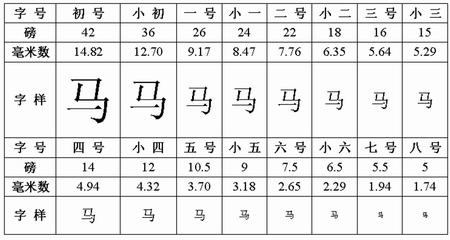
下表是字号与磅以及毫米之间的对应关系,并附以字样,以供大家在排版或调整布局时使用。

HTML和CSS中用的font size属性

Syntax: font-size: | | |
Possible Values:

*
o xx-small | x-small | small | medium | large | x-large | xx-large
*
o larger | smaller
*
* (in relation to parent element)

Both relative and absolute length units are supported in CSS1. Relative units give a length relative to another length property, and are preferred since they will better adjust to different media. The following relative units are available:

  • em (ems, the height of the element’s font)
  • ex (x-height, the height of the letter “x”)
  • px (pixels, relative to the canvas resolution)

Absolute length units are highly dependent on the output medium, and so are less useful than relative units. The following absolute units are available:

  • in (inches; 1in=2.54cm)
  • cm (centimeters; 1cm=10mm)
  • mm (millimeters)
  • pt (points; 1pt=1/72in)
  • pc (picas; 1pc=12pt)

要注意的是,相同大小的字体在不同的具体环境下显示出来的字体的真实大小可能不一样,差别比较小的可能是用px度量的大小。

关于x-height的定义可以看Typeface中的解释,简要的说是,对每一个字体都有一个假想的水平线叫baseline(想想小时候练习写英文字母的时候每一行都有三条或者四条横线那种作业本),x-height就是从baseline到字体最高处的高度。

Resources

  1. Font Size
  2. Point (typography)
  3. Typeface
  4. CSS改变字体大小而不影响网页
  5. 【知识】字体中“号”“磅”及“毫米”的关系
  6. Length Units

Technorati : , ,
Del.icio.us : , ,
Ice Rocket : , ,
Flickr : , ,
Zooomr : , ,
Buzznet : , ,

About Me

My photo
I'm finishing my master degree in Software Engineering, Computer Science. I believe and have been following what Forrest Gump's Mam said: you have to do the best with what god gave you.